Nigeria’s Social Vices as Fictional Products in Parody Advertising

Parody design is a form of creative expression where elements of existing designs, products, or brands are humorously or satirically imitated or exaggerated to convey a different message, often through humor, irony, or commentary.

My Master of Fine Arts (M.F.A.) thesis highlights and advertises as fictional products 10 rampant social vices that defined and characterised Nigerian society under the presidential administration of Nigeria’s immediate past president, Muhammadu Buhari: Bribery, Corruption, Cultism, Tribalism, Nepotism, Terrorism, Banditry, ‘Yahoo’, Kidnapping, and Free Speech Censorship.

The Viceland Exhibit: Nigeria's Social Vices.

Titled Nigeria’s Social Vices as Fictional Products in Parody Advertising, Chisom Uchendu’s landmark M.F.A. thesis portrays and advertises 10 rampant socio-political vices as commercial consumer commodities.

About My Master’s Thesis: Titled Nigeria’s Social Vices as Fictional Products in Parody Advertising, my Master of Fine Arts (M.F.A.) thesis highlights and advertises as fictional products 10 rampant social vices that defined and characterised Nigerian society under the presidential administration of Nigeria’s immediate past president, Muhammadu Buhari.

To varying degrees, the vices of bribery, corruption, cultism, tribalism, nepotism, terrorism, banditry, ‘yahoo’, kidnapping and free speech censorship were regular news headlines in Nigeria before 2015, when President Buhari first assumed the presidency. However, they took on unprecedented proportions under Buhari’s leadership (2015—2023). The steady rise in the incidence of these vices—especially under a leader who promised to eradicate some of them—propelled me to undertake a studio project where I depict the selected abstract vice concepts as relatable, real-world products within the framework of parody advertising.

Parody Advertising is a form of advertising that typically uses humour—in most cases satire and irony—to make commentary on existing commercial brands, products, advertisements, social or other issues, and sometimes, fictional products or concepts. Standing on my philosophy that the aforementioned vices are currently “staple products” of Nigerian society, I portray and parodically advertise each concept as a real, believable product that requires advertising like all real products do. Thus, the vices are brand products of Nigeria, and Nigeria is the brand company that produces and distributes them to the “target market”, or Nigerians.

I chose the design genre of parody advertising for my thesis because it allowed me to use the devices of satire and sarcasm in giving vent to my personal opinions on the issues under discussion in my work. Undertaking the exciting task of parodically advertising abstract vice concepts as fictional products put me in a position to think really critically and unusually about what the vices mean in light of Nigerian society today, and what type of visual representation was best suited for each one, in my opinion.

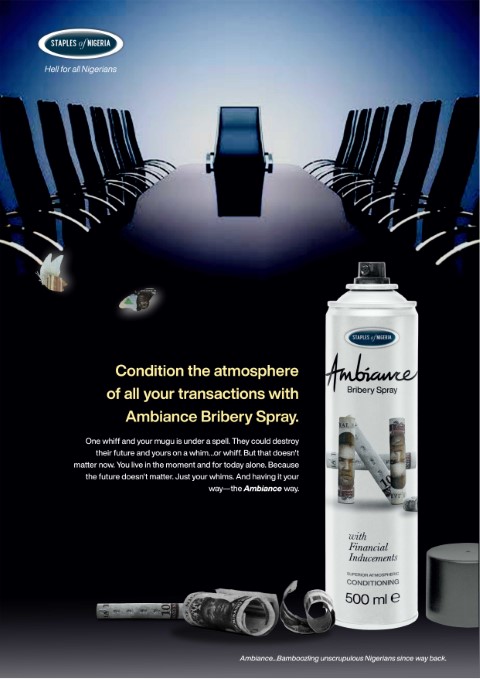
01 Ambiance Bribery Spray

Bribery

Ambiance Bribery Spray (500 ml)

The product of bribery is represented as a fragrance brand called Ambiance. Fragrances condition the smell of spaces into which they are released. In turn, fragrances determine how people respond to a conditioned space. The vice of bribery also possesses that tendency to condition or influence people. As such, the bribe giver and the bribe collector engage in a mutually beneficial transaction of conditioning and being conditioned respectively.

02 Corruption Mindset Software

Corruption

Corruption Mindset Software (CD Application)

Portrayed as an installable computer application in compact disc form. Corruption is often a learned behaviour, and can be imbibed, or installed, by anyone. While computer software makes changes to a computer that enable a programme to run, corruption is an acquired mindset that negatively influences perception and actions, making individuals more likely to engage in unlawful, depraved acts.

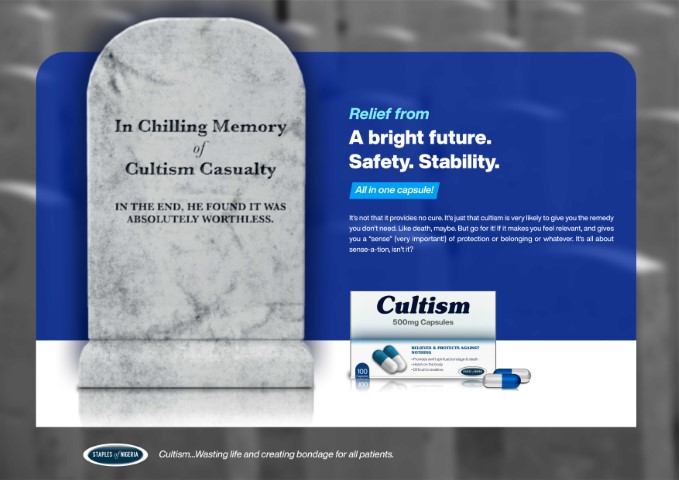
03 Cultism 500mg Capsules

Cultism

Cultism 500mg Capsules (100 Capsules)

Cultism is portrayed as medication because it shares with medicine the attribute of being able to provide prevention or remedy to an existing deficiency or malady. Cultism provides the initiate with a sense of belonging, power, and protection from evil, among other perks. The desire to make up for perceived inadequacies is often an incentive for cult membership.

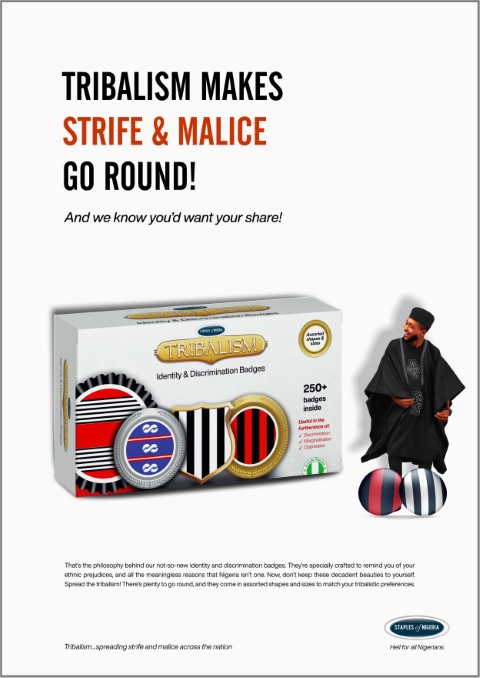
04 Identity & Discrimination Badges

Tribalism

Identity & Discrimination Badges (250+ Badges)

Depicted as a box of pin badges. Badges function as announcers of identity, status or rank. Like badges, tribalism is overtly displayed, announcing prejudices to the observer. On the package are badges representing the Igbo (okpu agu), Yoruba (aso oke & Bola Tinubu icon), Tiv (a’nger fabric), and Idoma (apa fabric), reflecting the deep ethnic prejudices between each group.

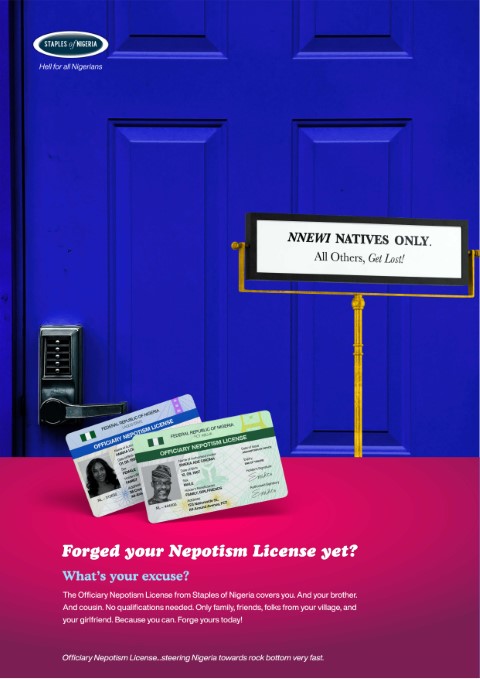
05 Officiary Nepotism License

Nepotism

Officiary Nepotism License (Male & Female Cards)

Designed as licence cards called Officiary Nepotism License. Nepotism manifests as a perceived entitlement to rights or privileges that lie beyond one’s reach—a self-conferred licence created in the mind to exploit situations to one’s selfish advantage. Personalised in two colors to communicate that nepotism is a highly personalised experience designed to suit individual desires.

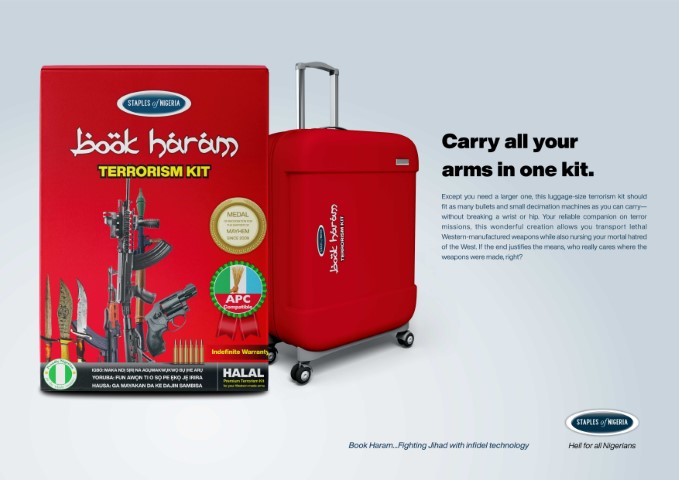
06 Book Haram Terrorism Kit

Terrorism

Book Haram Terrorism Kit (Luggage Kit)

Borrowing from the first aid kit concept, containing lethal weapons (bullets, pistols, shotguns, projectiles, daggers). Points out the irony of Boko Haram’s bitter antagonism towards Western-style education, despite fighting Jihad with highly sophisticated weapons produced in the West. Indicates the kit is perfectly halal even though its contents stem from what they deem haram.

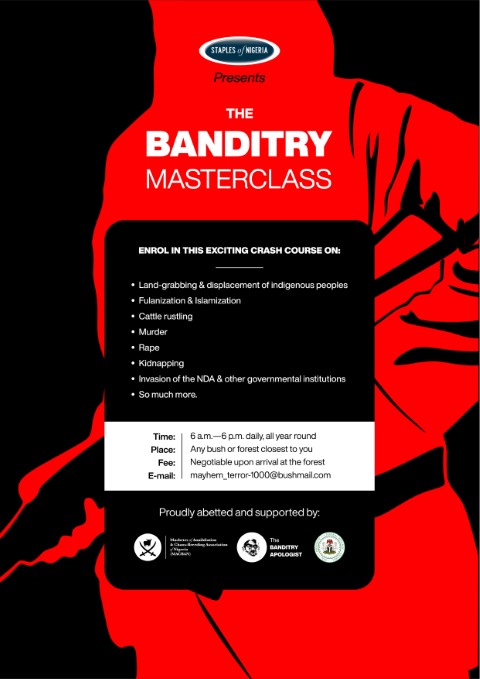
07 The Banditry Masterclass

Banditry

The Banditry Masterclass (Crash Course Poster)

A ‘Banditry Masterclass’ poster advertising the vice as a course to enrol in. Lists crimes passed off or minimised as “banditry” under the Buhari-led government: rape, kidnapping, wanton killing, invasion of indigenous villages, and cattle rustling. Mocks how banditry was euphemised into a lucrative business venture and alternative occupation.

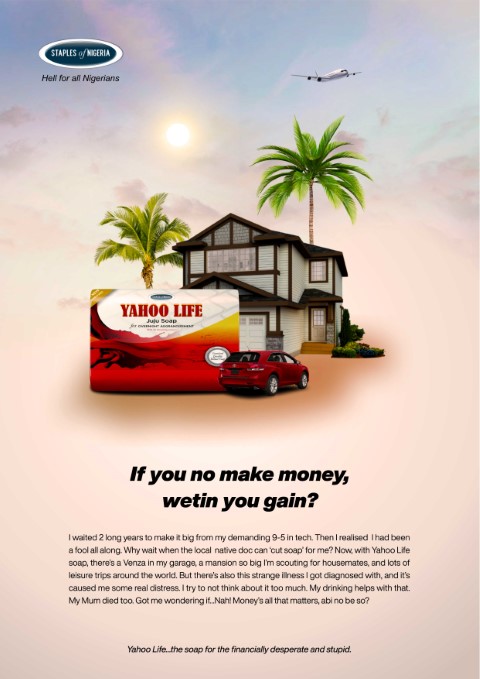
08 Yahoo Life Juju Soap

Yahoo

Yahoo Life Juju Soap (Bath Soap Bar)

Depicted as a bath soap reflecting the Nigerian concept of acquiring ‘soap’, or juju, to ensure success in cybercrimes (advance fee scam / ‘yahoo plus’). Fraudsters request ‘soap’ from local sorcerers to boost their diabolical schemes. The ‘soap’ concept in the yahoo lifestyle was the direct inspiration for depicting yahoo as a packaged soap bar.

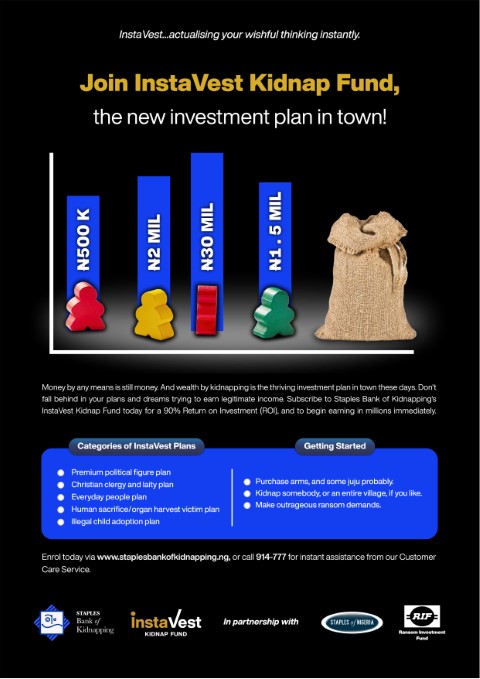
09 InstaVest Kidnap Fund

Kidnapping

InstaVest Kidnap Fund (Staples Bank of Kidnapping)

Portrayed as an investment banking advert by ‘Staples Bank of Kidnapping’. The outrageous ransoms demanded make kidnapping function like a financial investment scheme where ‘investors’ remedy their financial situation by extorting victims. The logo combines two facial expressions: a smile with a Naira sign eye (kidnapper) and a downcast eye with a black eye (victim).

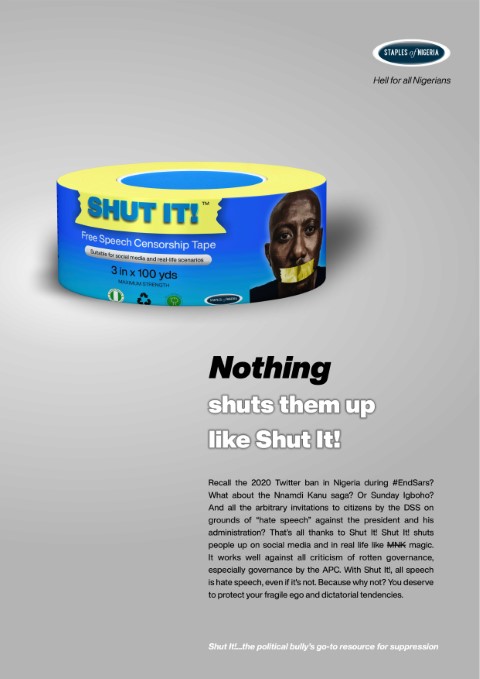
10 Shut It! Censorship Duct Tape

Free Speech Censorship

Shut It! Free Speech Censorship Tape (3 in x 100 yds)

Represented as heavy-duty duct tape brand Shut It!. Using duct tape as a visual metaphor for state-sponsored speech censorship (referencing the 2020 Twitter ban during #EndSARS and arbitrary interrogations), highlighting the Nigerian government's pettiness in trying to control citizens by censoring critical speech.

All Parody Campaign Plates.

Explore All 63 Curated Master Works

Discover works spanning branding, textile repeats, parody advertising, and environmental advocacy.

Open Archive (63 Works) Initiate Collaboration